
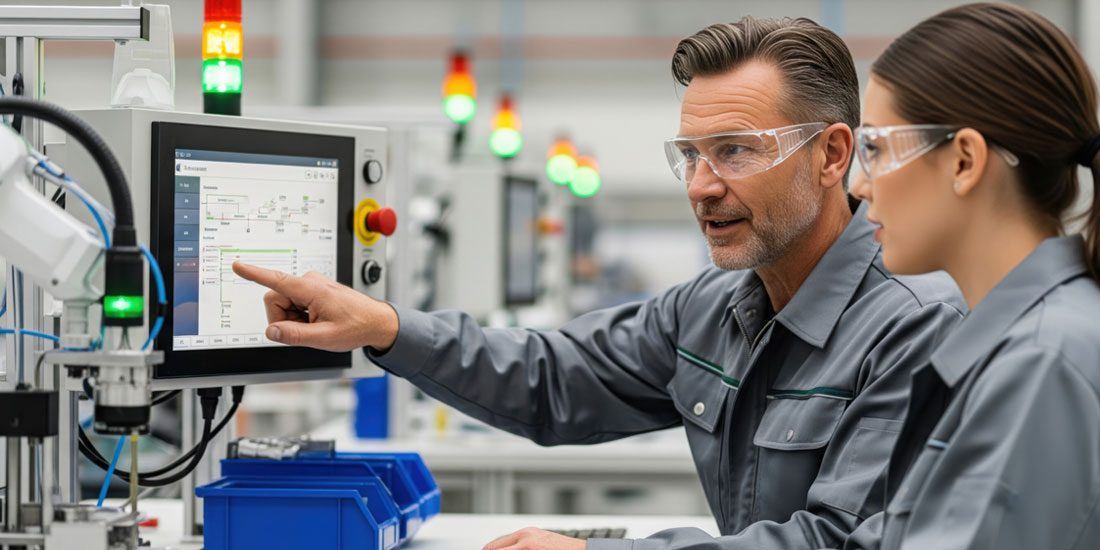
Onboarding is no longer something you can afford to leave to whoever happens to be free on a new hire’s first day. For industrial and manufacturing companies, three forces are converging to make structured onboarding a competitive requirement rather than an HR nicety.
The Labor Shortage Is Changing What Onboarding Has to Do
Fewer new hires arrive with industry experience, which means more onboarding programs are starting from zero rather than building on prior exposure to the shop floor. That shifts the burden onto the program itself: it has to teach fundamentals that used to be assumed.
At the same time, plants are under pressure to fill seats and get people productive fast, because every day someone spends learning by watching is a day of reduced output. Faster ramp up isn’t a nice outcome anymore, it’s a critical success factor.
Tribal Knowledge Onboarding Is Breaking Down
For decades, the default onboarding model in manufacturing was informal: pair the new hire with a veteran operator, have them shadow for a couple of weeks, and let knowledge transfer happen through observation and repetition. That model depended on two things that are increasingly in short supply — a stable, experienced workforce to do the training, and enough time to let it happen slowly.
As experienced operators retire, they take undocumented process knowledge with them. What’s left behind is often inconsistent: the new hire trained by your best line lead learns better than the one trained by someone who’s never had to explain the job out loud before. That inconsistency shows up later as variance in quality, safety incidents, and how long it actually takes someone to become reliable.
The Shift Toward Structured, Digital Onboarding Programs
In response, more manufacturers are moving away from ad hoc shadowing and toward documented, sequenced onboarding programs. Thy are creating defined paths through what a new hire needs to know, in what order, with checkpoints along the way. Video and interactive content are increasingly replacing one off verbal handoffs, because they can be delivered consistently to every new hire and revisited when something doesn’t stick the first time.
This isn’t about replacing hands-on training. Some things genuinely have to be learned by doing. It’s about making sure the parts that can be standardized (safety procedures, process steps, company expectations) are, so hands-on time can focus on judgment and machine feel rather than re-explaining basics.
What This Means for Manufacturers Right Now
Companies that move first on structured onboarding are seeing the benefit in two places: new hires reach full productivity faster, and fewer of them leave in the first 90 days — historically the point where the highest share of early turnover happens. Both of those numbers matter to the people funding this decision.
That raises the practical question: if you’re evaluating a move to a more structured program, what should you actually be looking for?
At the Sitaran Group, we have systemized new hire onboarding for industrial companies. We can help you rapidly develop and launch new hire onboarding programs that will provide a great ROI.