
by Reema Duggal | Aug 21, 2026
Buyers are researching vendors differently than they were even two years ago, and some industrial websites haven’t caught up.
AI Search Is Changing How Buyers Find You
Buyers increasingly reach vendors through AI answer engines instead of scrolling a page of search results.
Forrester’s 2026 Buyers’ Journey Survey of nearly 18,000 global business buyers found that: 94% used AI during their most recent purchase, often for more than one reason. 55% to compare vendors, 54% to research products, and 47% to build an internal business case before a vendor was ever contacted. AI answer engines now outrank company websites, sales reps, and product experts as the number one research source, and companies still optimizing for website traffic alone are seeing that traffic decline 10–40% as research shifts into these tools.
These systems favor sites with clear, specific answers over vague marketing copy. If a site can’t state plainly what it does, who it serves, and how, it gets passed over. Thin content that used to rank on keywords alone no longer holds up. Sites built around real industry language, actual specs, and concrete capability statements are the ones getting pulled into AI-generated answers, which means the writing on a site now matters as much as the design.
Buyers Are Comparing Evidence, Not Brand Stories
The buying committee scanning a site today is looking for evidence, not a brand story — certifications, tolerances, materials, lead times, compliance documentation, and language specific to their industry rather than boilerplate. Competitors who’ve built sites that actually look built for the buyer’s problem are winning that first impression before a call ever happens.
A polished, modern-looking site can still fail this test if the content underneath could belong to any company in any industry. Specificity is what separates the two, and a site that looks interchangeable with every competitor’s isn’t giving buyers anything to evaluate.
Self-Directed Research Is Outpacing Vendor Contact
Gartner’s research on B2B time allocation found buyers now spend roughly 27% of their total purchasing time on independent research, and only 5–6% of that time meeting with any single vendor. That’s a 5:1 ratio of self-directed research to direct vendor contact. Separately, Gartner reports 67% of B2B buyers now prefer a rep-free buying experience, up from 61% the year before. By the time a buyer raises their hand, they’ve often already narrowed the field to two or three vendors based on what the site showed them.
That reframes what a website actually needs to do. It’s not enough to describe capabilities anymore. The site has to support the evaluation itself, well before a sales conversation starts. Vendors who gate everything behind a call are increasingly filtered out of the shortlist before they even know a deal existed; the buyer just moves to the competitor whose site let them self-serve.
Buying Committees Have Grown, and So Has Friction
Buying groups have grown from roughly 5 to 16 decision-makers in recent years, and internal misalignment during the process is now common. Most committees report some friction working through it together. The engineer evaluating tolerances, the procurement lead comparing cost and lead time, and the finance stakeholder assessing ROI are often looking at the exact same page, and a site built for one of them rarely works for all three.
That growth is reshaping what a competitive site has to account for. A single generic page trying to serve every stakeholder increasingly reads as a page built for none of them, and the vendors adapting to that reality are the ones showing up favorably across the whole committee, not just to whoever picks up the phone first.
Does your company website meet current buyers need? We can help you audit and develop a plan to serve your potential customers.

by Reema Duggal | Aug 20, 2026
Industrial buyers evaluate a website the way they’d evaluate a vendor walking into their plant, looking for proof, not promises.
Proof Buyers Can Verify
Buyers trust specifics over statements. A page that says we’re the industry leader earns skepticism; a page with named case studies carrying real numbers — cycle times, yield, cost per part — earns credibility, and spec-first product pages with tables of tolerances, materials, certifications, and standards let a buyer confirm fit in seconds instead of taking a claim on faith. Visible proof of process, like quality certifications and audit history, placed where a skeptical engineer will actually look for it, does more work than any capabilities paragraph.
What buyers are really checking for is whether the vendor understands their exact industry, not industry in general — generic language, or proof that’s vague or hard to find, reads as a sign the vendor hasn’t done the work.
Tools That Let Them Self-Serve
Buyers want to evaluate fit without picking up the phone. Configurators and spec selectors that let a buyer narrow options on their own, ROI or cost calculators for the buyer already building an internal business case, and quoting logic that goes beyond “contact us for a quote” all let a buyer do real diligence on their own timeline.
When that self-serve path is missing, buyers don’t wait for it — they assume the vendor either doesn’t have this organized or isn’t prioritizing making it accessible, and neither impression helps close the deal. The vendors making it easy to move from “interested” to “here’s a number” are the ones converting that interest before it cools off.
Content Built for Their Specific Role
The buyer reading a site is rarely the only one who matters. The engineer wants a technical spec sheet, the procurement lead wants a cost and lead-time comparison, and the finance stakeholder wants a TCO or ROI breakdown — and a single generic page trying to answer all three questions usually answers none of them well.
Role-based content paths, along with downloadable, shareable assets a stakeholder can forward internally without looping the vendor in, matter because much of the internal selling on a buying committee happens without the vendor in the room. A site that gives each stakeholder something built for their specific question is doing part of that internal selling for the vendor.
Transparent Pricing or Budget Signals
Buyers want at least a directional sense of cost before they’ll invest real time in a deeper evaluation. A site that offers pricing ranges, cost drivers, or clear quoting logic — even loosely — lets a buyer rule a vendor in or out on budget fit early, before they’ve sunk hours into a conversation that was never going to work financially.
Sites that stay silent on cost until a call happens push that filtering work later in the process, which wastes time on both sides and often reads to the buyer as evasiveness rather than a deliberate sales strategy. A vendor doesn’t need to publish a full price list to give buyers something to work with here — just enough signal that budget fit isn’t a total unknown going in.
by Reema Duggal | Aug 20, 2026
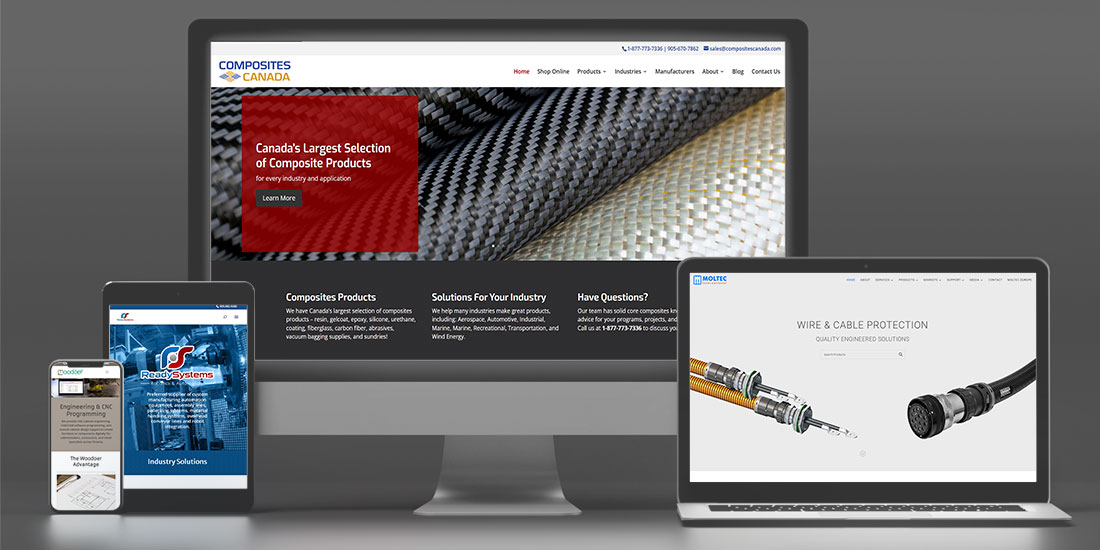
Industrial websites need to be focused on their customer’s industries. This focus helps customers feel that you understand their needs immediately, you answer their most pressing questions, and you provide them with the information and tools to get their job done fast.
What Makes a Website Industry Focused?
It comes down to specificity, not just visual polish. Here’s what that looks like in industry focused websites that we have helped our clients build:
Dedicated Pages Per Market or Vertical
Customers need to know you understand their market segment or vertical and can speak their language. Composites Canada lets their customers know immediately what they can do for each of the markets they serve: Aerospace, Automotive, Industrial, Marine, Marine, Recreational, Transportation, and Wind Energy. They also link top products per industry making it easy for customers to get what they need.
Self-Serve Technical Tools
Customers want their questions answered. Moltec International provides many important self service tools: Torque Guide, Chemical Resistance Chart, Conduit Selection Guide, and Part Number System. These reference tools let Engineers correctly spec a part without having to send emails or make calls..
Defined Engagement Workflows
Customers want to know how you work. Ready Systems lays out its engagement as a visible sequence — Needs Assessment, Proposal/Scope of Work, Engineering/Design, Manufacturing, Site Preparation, Shipping, Installation & Onsite Training, Site Acceptance Testing, Support — so a buyer knows exactly how the engagement will progress. This builds confidents in customers. Woodoer provides a cnc manufacturing process laying out how precision meets craftmanship.
Named Client Testimonials Tied To Outcomes
Customers want to know who you have worked with and how it went. While client logos are important, Ready Systems features direct quotes from customers in their website footer. They describe real project details, including a rapid two-line installation turnaround during a COVID-related supply delay.
Performance Claims Backed By Numbers.
Customers want specificity in claims. Moltec International states its conduit is rated for over 10 million reverse bending cycles — a concrete, verifiable claim instead of a vague durability statement.
Certifications Explained
Customers want to know your expertise and your quality standards. Moltec International explains that its UL Listed certification confirms compliance with the National Electrical Code and Canadian Electrical Code. Composites Canada ties its ISO 9001 certification directly to its quality process.
Enquiry/Quote Carts
Customers want pricing information on complex jobs. Engineers are often building out specs for projects and need projected pricing for various assemblies and volumes. Moltec International’s ]Request A Quote enquiry cart lets a buyer add products across several different product categories and request one quote for the full set. The quote cart lets them get expert help and pricing, but also engages the sales team to make sure they are getting the right products. .
eCommerce Catalogs
Some customers want to be able to buy now. Composites Canada provides an online shop with thousands of products organized by product category, letting a buyer browse actual SKUs and specs without ever picking up the phone.
Does Your Industrial Website Need A Redesign / Rebuild?
This depends on whether the problems are surface-level or structural. If the current site’s foundation: its content management system, content structure, and technical performance is sound but the design and messaging feel dated, a redesign is usually enough. If the underlying platform can’t support the content, integrations, or performance a modern site needs, a rebuild is the better investment.
How Long Does a Project Take?
Timelines vary mainly based on content readiness and integration complexity, not design work. A site with existing, organized content and few integrations can move quickly; a site that needs new content written from scratch, or that connects into an enterprise resource planning system or quoting system, takes longer.
A Technical Aside
A few technical decisions shape how well a site performs long-term.
- the content management system should be flexible enough for non-technical staff to update content without a developer
- hosting should be reliable enough to support traffic spikes without slowdowns
- Integrations with the customer relationship management system and enterprise resource planning system must be planned early
- How individual sections are written matters too: question-format headings and front-loaded, direct answers make content easier for AI answer engines to pull into their responses, not just easier for a human to scan.
We Can Help You
We help industrial companies build industry driven websites that drive revenue and keep customers coming back.

by Reema Duggal | Aug 19, 2026
B2B buyers are shopping more like consumers, and the suppliers who sell to them are having to catch up fast. Here’s what’s actually changing right now.
AI Agents Are Influencing How Suppliers Get Discovered
AI-assisted purchasing is beginning to shape how suppliers get discovered and evaluated, adding a new layer earlier in the buying process. An AI purchasing agent is scanning supplier sites and catalogs, comparing what’s available, and narrowing the field before a person ever picks up the phone.
That means a catalog now has two audiences at once:
- a human scanning visually, and
- a machine parsing structured data.
Suppliers with clean, well-structured product data are more likely to make the shortlist. Suppliers whose specs live only in PDFs and phone calls are increasingly invisible to it.
High Value B2B Deals Are Increasingly Happening Online
Buyers driving that shift expect the same personalization they get everywhere else in their daily lives. According to software vendor BigCommerce, Millennials now make up the majority of B2B buyers, and their day-to-day purchasing habits are shaped by platforms that already know their history, their preferences, their account.
Meeting that expectation starts small: account-based pricing, order history, and saved lists go a long way. What no longer works is treating every buyer identically, the way a printed catalog always had to.
eCommerce Handles Most Standard Products
For B2B companies, eCommerce works best for the products a buyer already knows they want: standard items, fixed configurations, things that don’t need a conversation to spec correctly. A buyer might still have a quick question along the way, answered by a chatbot or a quick call, but that’s usually a product-fit question like “will this work for what I need,” not something that requires a deeper conversation.
A catalog that displays products but doesn’t reflect real-time pricing, or doesn’t route into your actual order and payment processes, is solving half the problem. The suppliers pulling ahead treat their online presence as infrastructure the whole commercial operation runs through, built to last past a launch date.
Automation Is Raising the Value of Human Sales Expertise
Automating the routine parts of buying frees sales teams to spend more time on the deals that actually need a person: complex configurations, strategic accounts, problems a catalog can’t solve alone. That’s the opposite of what a lot of suppliers fear when they hear automation.
Reordering, browsing, and basic quoting can move to self-serve. The time that frees up sharpens what sales spends its attention on: the accounts and problems where expertise actually moves a deal.
Knowing what’s changing industry-wide is only half the picture. The next question is what your buyers specifically expect once they land on your site.

by Reema Duggal | Aug 19, 2026
Once a buyer lands on your site, the trends shaping the industry turn into specific, practical expectations. Here’s what they’re actually evaluating.
Search That Understands Buyer Intent
Buyers need search that reads what they’re trying to find. A search for a part described in plant-floor language should return the right result even if it doesn’t match your product titles exactly. Semantic search closes that gap and cuts the zero-result searches that send buyers back to the phone or to a competitor.
This matters more for industrial catalogs than consumer retail, because part numbers, specs, and internal naming conventions rarely match how a buyer actually describes what they need. Search built around your taxonomy, not theirs, quietly turns buyers away before they ever see what you carry.
Accurate, Real-Time Pricing and Inventory
Buyers want to see exact stock levels, real delivery dates, and pricing that reflects their actual account: not a placeholder that requires a call to confirm. Complex B2B pricing, volume breaks, account-specific rates, contract pricing, used to be a reason to keep pricing offline. Buyers now expect that complexity to be handled online anyway.
A price shown that doesn’t hold up when they call is worse than showing no price at all. It damages trust in every number that follows it. Accuracy here isn’t a nice-to-have; it’s the thing that determines whether a buyer trusts the rest of the site.
Easy Reordering
Buyers who’ve ordered from you before want reordering to take seconds. They already know what they need: pulling up a past order, confirming quantity, and submitting again shouldn’t take longer than the decision to reorder itself.
Low-friction reordering matters because repeat purchases are usually your highest-volume, lowest-risk revenue. Friction there costs you the easiest business to keep, since a buyer who has to hunt for the right SKU again, or call to reconfirm pricing, has an opening to check a competitor instead.
Fast + Free Shipping
Delivery dates need to be fast and transparent. A delivery date buyers can see up front, without a follow-up email to confirm it, does more for trust than shaving another day off the actual shipping time.
Buyers expect free shipping built into pricing rather than negotiated case by case. That expectation is shaped as much by consumer platforms like Amazon as it is competitors, and it now applies to industrial purchasing too.
Payment Flexibility That Matches How They Actually Buy
Buyers need payment options that match how their own finance departments operate: electronic invoicing, PO numbers, and secure integration with their accounting systems, not just a credit card field. A B2B purchase usually isn’t one person’s decision or one payment method; it moves through an approval and reconciliation process a consumer checkout flow was never built for.
A catalog that only supports card payment is quietly excluding a lot of legitimate B2B buying behavior, not because the buyer doesn’t want to purchase, but because your checkout doesn’t match how their company actually pays.
Knowing what buyers expect is the easier part. The harder questions are the ones you’ll actually face once you start planning the build itself.